Autism Doesn't Have an Age Limit, and Neither Does Good Support
Community Disability Care · 6 Aug 2026
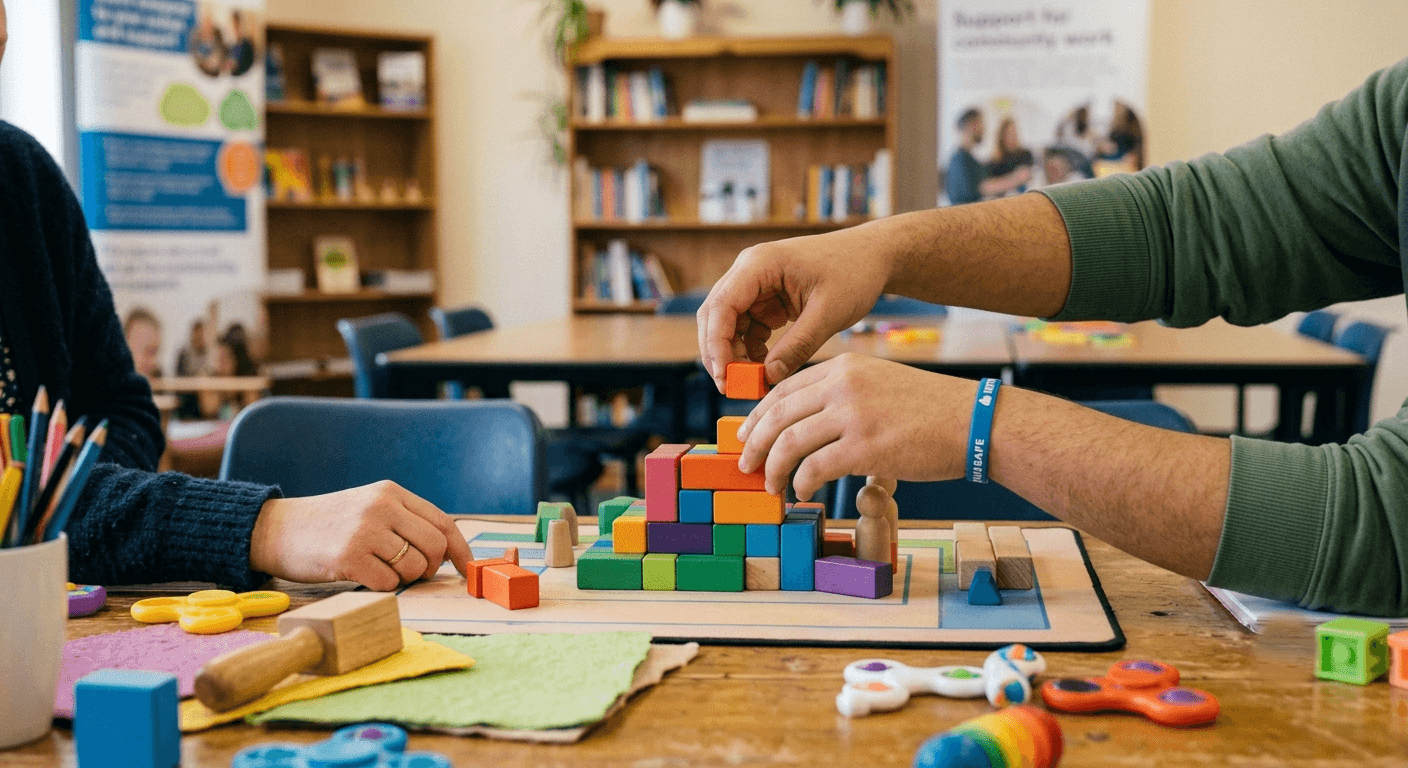
People tend to picture one thing when they hear "autism support": a young child, maybe in a classroom, maybe with a therapist doing flashcards on the floor. That picture isn't wrong, it's just incomplete. Some of the people we support are seven. Some are seventeen. One of our longest-standing participants is in his fifties and was only diagnosed four years ago, after a lifetime of being told he was just "difficult" or "too sensitive." Autism doesn't switch off at eighteen, and it doesn't announce itself the same way twice. What we've learned, mostly by listening, is that good support has to change shape depending on who's in front of us.
Take Zac (name changed), seven years old, who came to us because school had become something his parents dreaded every morning. It wasn't the classwork. It was the bell, the fluorescent lights, thirty other kids talking at once, the fire drill nobody warned him about. Nobody around him was doing anything wrong, the environment was just louder and brighter than his nervous system could process without cost. We didn't try to make Zac tolerate more noise. We worked with his family and his school on small, specific things: noise-reducing headphones he could put on without asking permission, a visual schedule so transitions weren't a surprise, a quiet space he could go to before he hit the point of no return, not after. Within a term, mornings stopped being a fight. Zac wasn't "fixed." The environment around him finally matched how he actually takes in the world.
Then there's Priya (name changed), sixteen, who didn't want headphones or a quiet room. What she wanted was to catch the bus to TAFE on her own, the way her friends did, without her mum driving her because everyone assumed she couldn't manage it alone. She could talk, she could plan, she just needed the actual route practised enough times that it stopped being a wall of unknowns. So that's what we did, the same route, the same bus, several times, with a support worker a few steps behind and then a few steps further behind, until one Tuesday she did it without anyone behind her at all. Her mum cried in the car park. Not because it was a small thing. Because for years everyone had assumed it was impossible, and it turned out it just hadn't been tried in a way that matched how Priya actually learns.
And there's Robert (name changed), fifty-one, diagnosed as an adult after decades of being misread by people who never had the language for what they were seeing in him. Robert didn't need us to teach him who he was. He needed practical, dignified support to live on his own for the first time after his mother, who'd looked after him his whole life, passed away. That meant a support worker who didn't talk over him, routines built around his actual preferences rather than a generic checklist, and enough patience for him to do things his own way even when our way might have been faster. Robert isn't a case study in overcoming autism. He's a man learning to run his own household at fifty-one, and our job is to make that genuinely his, not ours with his name on it.
Three completely different people, three completely different support plans, and honestly, almost nothing about the day-to-day looks the same across them. What stays constant is the starting question: what does this specific person actually need to do the things that matter to them, not what does "an autistic participant" generically need. We don't run a standard autism program that gets applied regardless of who walks through the door. We spend real time working out how someone communicates, what overwhelms them, what they're capable of that other people have assumed they aren't, and we build the support around that, at whatever age they happen to be when they come to us.
That also means being honest when a family's expectations and a participant's actual goals don't line up, which happens more than people expect. Sometimes a parent wants more structure than their adult child wants for themselves. Sometimes a school wants compliance where we think the participant needs accommodation instead. We'd rather have that harder conversation early and directly than quietly go along with a plan that isn't really about the person it's meant to be for.
If you're supporting someone autistic, at any age, and the plan they're on feels like it was written for someone else, that's worth a conversation. It's the same conversation whether the person in question is seven or seventy.
Have questions about your NDIS plan?
Get in Touch